
GASCÓN Lighting Guide · updated in September 2026
The short answer
- Ceiling flush mounts attach to the surface of the ceiling and are visible. Downlights are recessed into the ceiling and are nearly invisible. Spotlights are surface-mounted and adjustable. They solve different problems.
- Look at lumens, not watts. Practical guide: about 100 lm per m² for general lighting, and 300 lm per m² for kitchen work areas or in front of the bathroom mirror.
- An average flush mount in our catalog provides 2,400 lm: enough for a living room of about 20–24 m². An average downlight provides 500 lm, so you would need four or five to achieve the same.
- In the bathroom, the IP rating is not optional. At least IP44 near the shower.
- 2,700–3,000 K for living rooms and bedrooms; 4,000 K for kitchens, bathrooms, and work areas.
1. Flush mounts, downlights, and spotlights are not the same
It is the most common confusion, and you pay for it during installation.
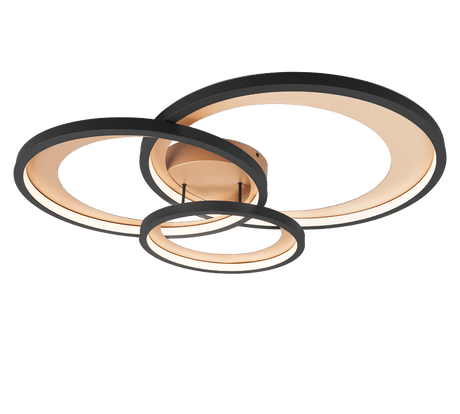
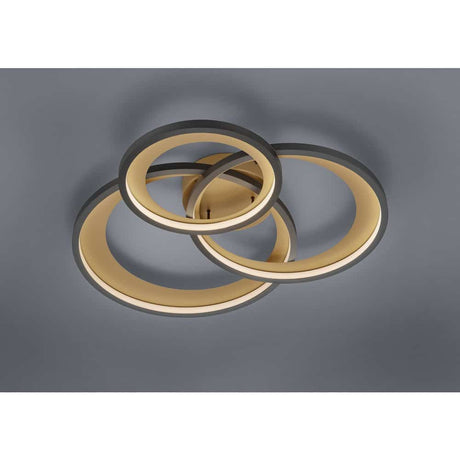
The flush mount screws onto the ceiling surface. It does not require construction or a dropped ceiling: two anchors and you're done. It is the solution for the vast majority of Spanish homes with concrete slab ceilings. We have 1,455 indoor flush mounts available, with a median price of €128.85.
The downlight is recessed: a hole is made in the ceiling and the fixture sits flush. It requires a dropped ceiling or plasterboard—and a few centimeters of space behind it. In return, it disappears: light emerges from the ceiling without seeing where it comes from. We have 308 downlights, with a median price of €25.99. They are much cheaper per unit because you need several.
The spotlight is surface-mounted, like a flush mount, but it is adjustable. It is used to direct light onto a painting, a shelf, or a countertop, not to illuminate an entire room.
The deciding question: do you have a dropped ceiling? If you don't, and you aren't planning on construction, your answer is a flush mount, not a downlight.
2. How much light you need: lumens, not watts
Watts measure consumption. Lumens measure brightness. With LED, the relationship between the two is no longer what it was with incandescent bulbs, so watts are no longer a useful reference.
Practical rule of thumb to guide you:
| Room | General light | Example |
|---|---|---|
| 20 m² living room | ~2,000 lm | a 2,400 lm flush mount is more than enough |
| 14 m² bedroom | ~1,400 lm | a 1,500–2,000 lm flush mount |
| 10 m² kitchen | ~1,000 lm general + 300 lm/m² over the countertop | flush mount + spotlights or downlights over the counter |
| Hallway | ~100 lm/m² | small flush mounts or downlights every 1.5 m |
In our catalog, the median for an LED flush mount is 2,400 lm, and the top 10% most powerful exceed 4,900 lm. The median power is 22 W—a figure that well illustrates how outdated the old equivalence has become: 22 W of LED provides as much light as 150 W of incandescent.
⚠️ Two honest warnings. First: only 67% of flush mounts declare their lumens on the spec sheet, because many use separate E27 bulbs, meaning the light output depends on the bulb you choose, not the fixture. Second: for downlights, only 40% declare them for the same reason—most are GU10 and come without bulbs.
3. Downlights: how many and at what distance
This is where the expensive mistake happens, because once the holes are made, there is no going back.
How many. Divide the total lumens you need by the lumens provided by each downlight. For a 20 m² living room (about 2,000 lm) with 500 lm downlights—which is our median—you get four. If the downlight is 350 lm, you get six.
At what distance. Standard practice is to space them approximately the height of the ceiling: with a 2.50 m ceiling, place them 1.20 to 1.50 m apart. And half that distance from the wall, about 60–75 cm, so the wall is illuminated and the room doesn't look like a cave with spots of light in the center.
Watch the angle. A 30° downlight creates a narrow, sharp circle; one of 60° or more spreads the light. For general lighting, you want a wide angle. For illuminating a specific shelf, a narrow one.
And the clearance. Before buying, measure the cutout diameter (not the outer diameter) and how far it extends behind the ceiling. In a plasterboard ceiling with little space, a deep downlight won't fit.
4. The bathroom and kitchen: where IP is not optional
The IP rating tells you how much water and dust the device can withstand. It is the only data in this guide that isn't an aesthetic recommendation: it is for safety and is part of building regulations.
- IP20 — not protected against water. This is standard for living rooms, bedrooms, and hallways. 74% of our flush mounts are IP20.
- IP44 — protected against splashes. This is the minimum for the bathroom outside the shower area, and for kitchens near the sink.
- IP54 / IP65 — protected against splashes and jets. For inside the shower area and for covered outdoor areas.
In our catalog, there are 78 flush mounts and 52 downlights with IP44 or higher. It's not that there are few: it's that the bathroom is only a small fraction of the house, and the rest of the rooms don't need it.
Real examples, from cheapest upwards:
- Faro Flac GU10 IP65 Recessed Downlight — €8.99. IP65: suitable even inside the shower.
- Incolamp Satin Nickel Recessed Spotlight IP54 — €10.38.
- Faro Hyde GU10 IP44 Downlight — €13.99.
- Trio Virunga LED Bathroom Flush Mount IP44 Ø11 cm — €16.00. 900 lm and switchable temperature 2,300/3,000/4,000 K.
- Trio Putz II LED Flush Mount IP44 Ø27 cm, dimmable — €16.00. 1,160 lm, 3,000 K: the choice for a medium bathroom with a single light point.
More in bathroom downlights and kitchen downlights.
5. Color temperature: the most noticeable mistake
Kelvin (K) measures whether light is warm or cool. It has nothing to do with power.
- 2,700–3,000 K (warm) — living room, bedroom, dining room. It is the light that invites you to stay.
- 4,000 K (neutral) — kitchen, bathroom, office, garage. This is the light that lets you see clearly what you are doing.
- 6,000 K and above (cool) — workshops and technical areas. Rarely used in a home.
Among our flush mounts, 3,000 K is the most common value, followed by 4,000 K. But there is a third option that solves the dilemma from the start: 248 flush mounts are CCT dimmable, meaning they change from warm to cool using the switch or a remote. If you are unsure which temperature to use in a room, that is the answer.
- Trio Kibo LED CCT Flush Mount Ø11.8 cm — €19.00. 500 lm, switchable 3,000/4,000/6,000 K.
- Trio Joko LED CCT Flush Mount Ø42 cm — €33.00. 2,700 lm and the full range from 2,700 to 6,500 K.
- Trio Rotsund LED CCT Flush Mount Ø38 cm matte black — €36.90. 3,000 lm.
6. What to buy
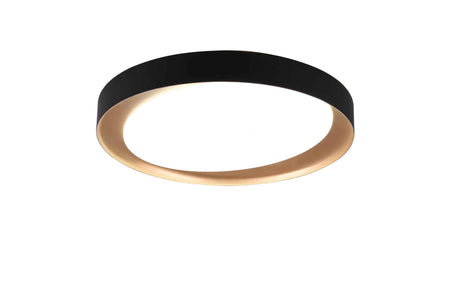
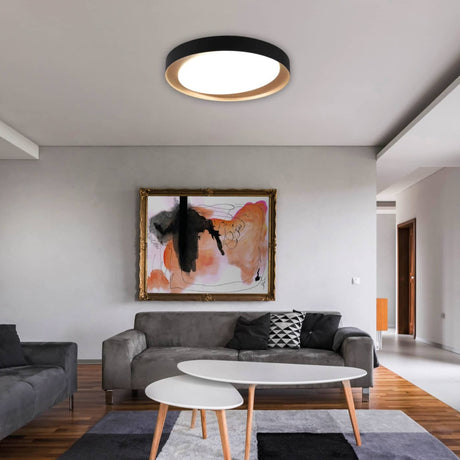
A single flush mount for a living room — Trio Umbria VI LED 4,000 K Ø40 cm · €25.00 2,500 lm in one fixture. Covers a 20–25 m² living room without anything else.
If you want to be able to change the light according to the time of day — Trio Joko LED CCT Ø42 cm · €33.00 2,700 lm and from 2,700 to 6,500 K.
For the bathroom, with a single light point — Trio Putz II LED IP44 dimmable Ø27 cm · €16.00
For a shower or a covered outdoor ceiling — Faro Flac IP65 · €8.99
A small hallway flush mount — Trio Nimbus LED IP44 8.5 cm · €16.00 450 lm, dimmable, and with IP44 in case the hallway connects to a terrace.
Full catalogs: ceiling flush mounts · LED flush mounts · LED downlights · recessed spotlights and downlights · ceiling spotlights
7. Five common mistakes
- Buying downlights without a dropped ceiling. There is nowhere to put them. Use a flush mount.
- Choosing by watts. An 18 W LED can provide more light than a 24 W one. Look at the lumens.
- Using IP20 in the bathroom. It's a safety error, not a matter of taste.
- A single downlight per room. It creates a cone of light in the center and shadows elsewhere. Downlights are designed as a set, never one by one.
- 6,000 K in the bedroom. That is operating room light. The room will not be restful.
Frequently asked questions
What is the difference between a flush mount and a downlight?
The flush mount is mounted on the ceiling surface and remains visible; the downlight is recessed into the ceiling and sits flush. The downlight requires a dropped ceiling or plasterboard with space behind it; the flush mount requires no construction. If your ceiling is a concrete slab and you aren't going to build a dropped ceiling, the answer is a flush mount.
How many lumens do I need for a living room?
As a guide, about 100 lumens per square meter for general lighting: a 20 m² living room requires about 2,000 lm. The median for our LED flush mounts is 2,400 lm, so a single flush mount is usually sufficient. If you also want light for reading, add a floor lamp with a reading light.
How many downlights are needed and at what distance should they be placed?
Divide the lumens you need by the lumens each downlight provides—the median in our catalog is 500 lm per unit. For a 20 m² living room, that's four or five. The usual spacing is approximately the height of the ceiling (1.20–1.50 m for a 2.50 m ceiling), and half that distance from the wall.
What IP do I need in the bathroom?
At least IP44 in the area near the shower or bathtub, and IP65 if the fixture is inside the shower area itself. Outside the wet area, IP20 is acceptable. We have 78 flush mounts and 52 downlights with IP44 or higher.
Which color temperature should I choose, 3,000 K or 4,000 K?
3,000 K in the living room, bedroom, and dining room because it is warm and cozy light. 4,000 K in the kitchen, bathroom, and office because it is neutral light and makes details easier to distinguish. If you are in doubt, there are CCT dimmable flush mounts that do both: we have 248 in our catalog.
Can I put an LED flush mount on a dimmer switch?
Only if the flush mount is indicated as dimmable. A non-dimmable LED connected to a dimmer will flicker, hum, or break. We indicate this on each product page; for example, the Trio Putz II and Trio Nimbus in this guide are dimmable.